Two Breeds, Two Continents, One Purpose
The Bernese Mountain Dog and the Poodle: How Two Very Different Histories Produced the Perfect Cross
The Bernese Mountain Dog: A Farm Dog from the Swiss Alps
Long before they had a breed name, the dogs that would become Bernese Mountain Dogs were simply part of life in the Canton of Berne. Farmers in the Dürrbach region near Riggisberg called them Dürrbächler: sturdy, tri-colored working dogs that guarded homesteads, moved cattle, and pulled carts loaded with milk and cheese down mountain roads to market. They were cowherds' dogs, known locally as Küherhunde, and they had been doing this work for centuries.
These dogs were woven into every part of family life: large enough to haul a loaded cart, calm enough to stand quietly at a market stall, gentle enough to lie beside children on the farmhouse floor, and loyal enough to walk home beside their owner without a leash. The Bernese temperament that families love today (that steady, unshakable calm) comes from centuries of living alongside families in the Swiss Alps, where the dog was not separate from the household but part of it.
In 1907, a group of breeders and merchants in Burgdorf began the formal effort to preserve the breed. Three years later, a gathering in the same town attracted 107 local dogs, 99 of which were judged to be true Dürrbächler type. The breed was not on the verge of extinction, as some accounts suggest. It was thriving in the countryside. It simply had not yet entered the world of formal dog shows and breed registries.
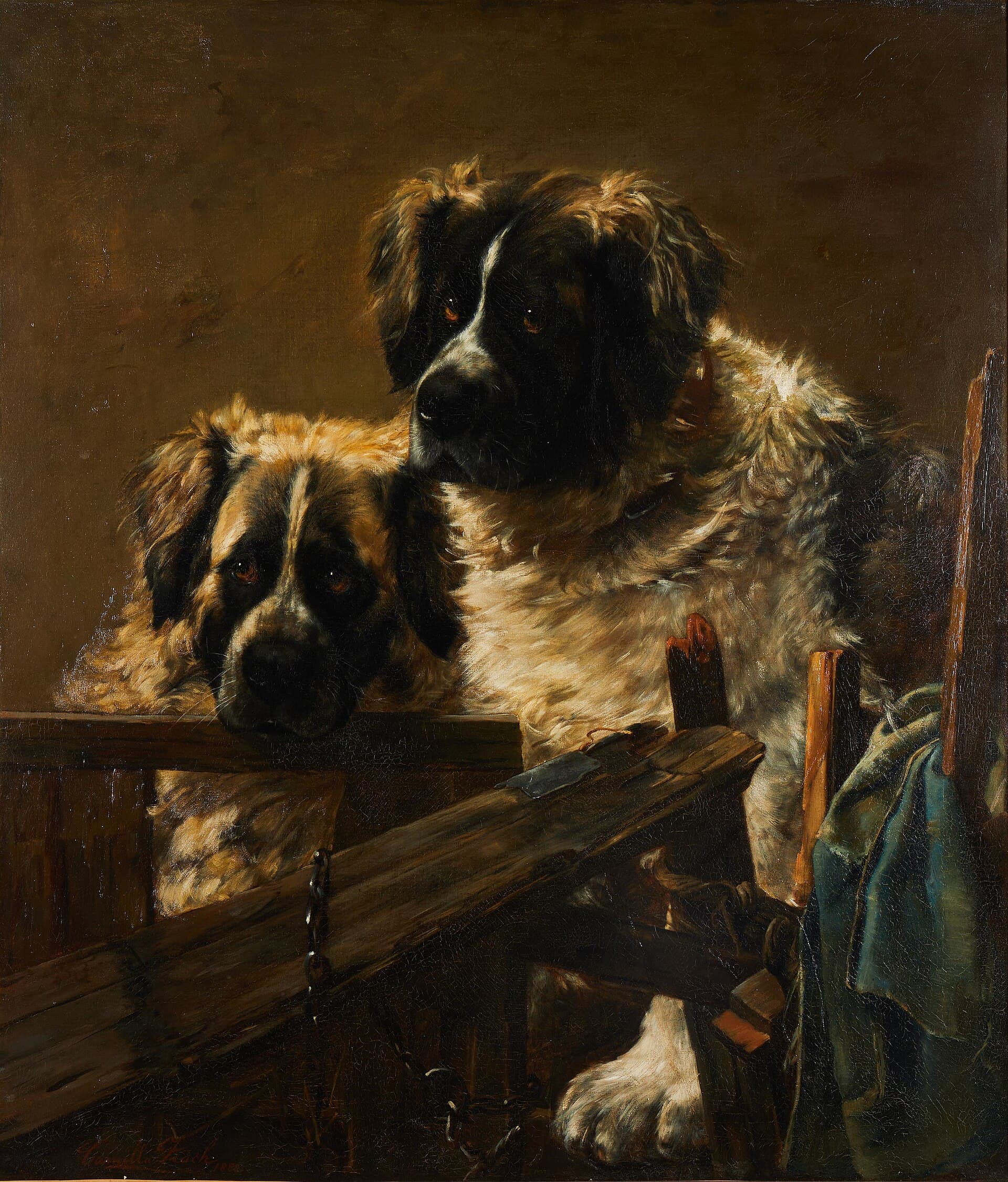
Camilla Zach-Dorn, Zwei Berner Sennhunde, 1888. Oil on canvas. Public domain, via Wikimedia Commons.
Crossing the Atlantic
The Bernese Mountain Dog arrived in the United States in 1926, when a pair named Donna von der Rothöhe and Poincaré von Sumiswald were imported to Kansas. For over a decade, the American population of Bernese Mountain Dogs depended on a remarkably small number of dogs and dedicated owners. Glen L. Shadow later imported additional dogs (Fridy v. Haslenbach and Quell v. Tiergarten), and his efforts helped the breed achieve American Kennel Club recognition in 1937.
The Bernese Mountain Dog Club of America was formed in 1968, and with it came the infrastructure for organized breeding, specialty shows, and health tracking. By 1981, the club had earned full AKC member status. In 1995, the Berner-Garde Foundation was established to maintain open-access pedigree and health databases, an early and admirable commitment to transparency that many other breed clubs have yet to match.
But there was a cost to this small-population origin story. The American Bernese gene pool was built from a narrow genetic base. Over decades of closed-registry breeding, that narrowness compounded. The health consequences (rising rates of histiocytic sarcoma, shortened lifespans, orthopedic problems) are not random misfortune. They are the predictable result of a shrinking gene pool, and they are the reason so many Bernese lovers have turned to the Bernedoodle as a path forward.
The Poodle: Not What You Think
If the Bernese Mountain Dog suffers from being underestimated, the Poodle suffers from being misunderstood. Most people picture a Poodle and see a prissy show dog with an elaborate haircut. The reality is almost the opposite.
The Poodle is one of the oldest and most athletic working breeds in existence. Originating in Germany (not France, despite the common association), the breed was developed as a water retriever. The name itself comes from the German word 'pudeln,' meaning to splash. These were dogs bred to leap into freezing rivers and lakes to retrieve ducks and other waterfowl for hunters. The iconic Poodle clip, far from being decorative, was originally functional: hair was left long over the joints and vital organs for warmth, and shaved elsewhere to reduce drag in the water.
Poodles are among the most intelligent dog breeds ever tested. They learn quickly, adapt to new situations with ease, and have an eagerness to work with their handler that makes them exceptional at everything from obedience and agility to service work and therapy. They have also been bred for centuries to be included in family life, from the French aristocracy who adored them as household companions to the circus performers who relied on their trainability and showmanship. They come in three sizes (Standard, Miniature, and Toy), all of which are the same breed, just scaled differently through generations of selective breeding.
But the Poodle has its own genetic story to reckon with. During decades of show ring popularity, the desire to solidify specific physical traits led to the heavy use of popular studs: individual dogs who sired an outsized number of litters because they won in the ring. This practice, repeated across generations, took what was once a genetically diverse population and significantly narrowed it. The same pattern that devastated the Bernese (prioritizing aesthetics over genetic health) played out in the Poodle world as well, just less visibly because the Poodle's longer lifespan masked the consequences for longer.
Critically for the Bernedoodle story, Poodles still bring essential contributions: genetic diversity from a completely separate gene pool, a dramatically longer average lifespan, and the RSPO2 furnishings gene that produces low- to non-shedding coats. The Poodle is not a cosmetic addition to the Bernedoodle. It is the genetic engine that makes the cross viable for modern family life, and the cross, in turn, helps restore the diversity that both breeds have lost.
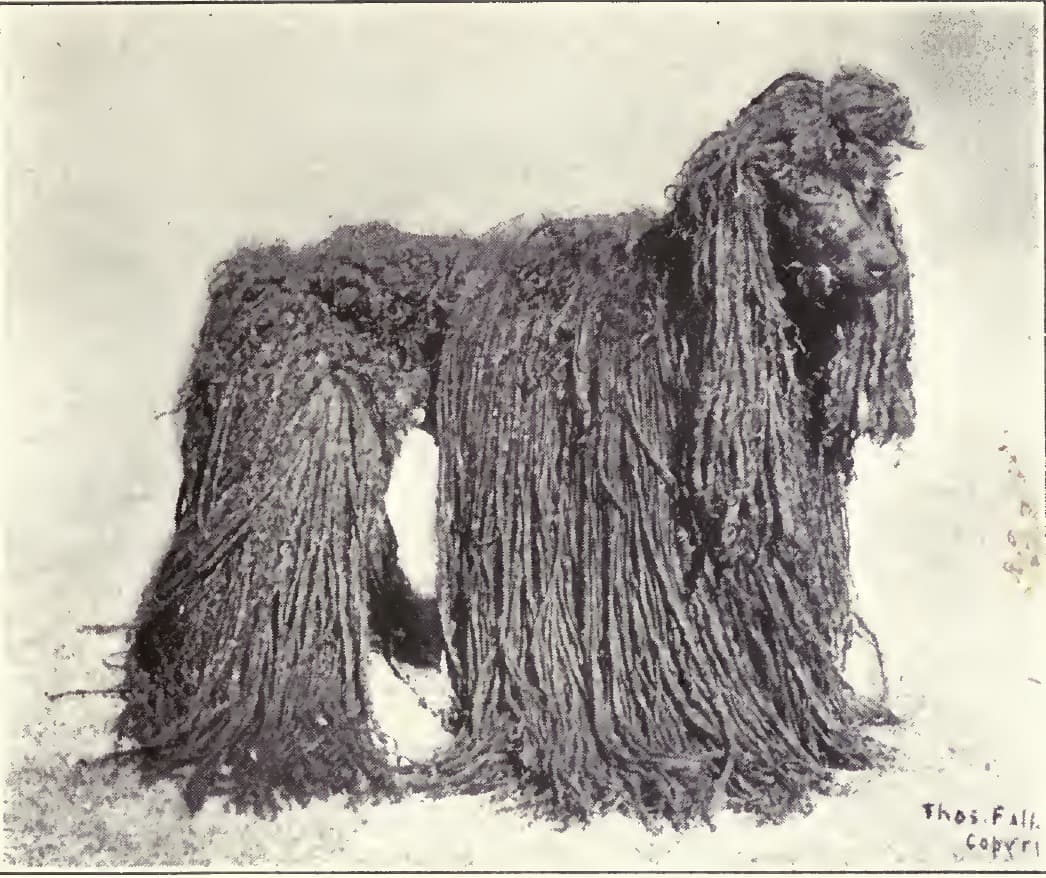
Corded Poodle, 1915. From W.E. Mason, Dogs of All Nations. Photo: Thos. Fall. Public domain; digitized by the Internet Archive.
Why These Two Breeds Fit Together
On paper, the Bernese Mountain Dog and the Poodle seem like an unlikely pair. One is a heavy-boned Alpine farm dog built for cold weather and slow, steady work. The other is a lean, athletic water retriever built for speed and agility. But look closer and the complementarity is striking.
The Bernese brings calm. The Poodle brings intelligence. The Bernese brings loyalty and physical presence. The Poodle brings longevity and a non-shedding coat. The Bernese brings a temperament so steady it borders on stoic. The Poodle brings adaptability and trainability that opens doors to therapy work, service roles, and complex family dynamics.
Where the Bernese is vulnerable (cancer risk, joint problems, a lifespan that has declined to an average of six to eight years in some lines), the Poodle is stronger. Standard Poodles routinely live twelve to fifteen years. And while the Poodle's own genetic diversity has been narrowed by decades of show ring practices, it still represents a completely separate gene pool from the Bernese, and the cross between the two restores the kind of diversity that both breeds need.
The Bernedoodle is not a dilution of either breed. It is a combination that addresses the most serious limitations of both while preserving what makes each one extraordinary. The Bernese warmth, the Poodle brain, the best health profile available from both gene pools, brought together not by accident, but by breeders who understood what each breed needed from the other.
From Working Dogs to Family Dogs
Both the Bernese Mountain Dog and the Poodle have always been family dogs, not in spite of their working heritage, but because of it. The Bernese lived in the farmhouse, slept near the children, and spent every day alongside the family. The Poodle was a constant companion in the home, prized not just for its working ability but for its loyalty, warmth, and desire to be near its people. Both breeds developed a deep, intuitive connection to their humans that has only deepened over centuries of shared life.
That is what makes the Bernedoodle different from many other crossbreeds. It is not a pairing of convenience or aesthetics. It is two working breeds, each with centuries of human partnership in their DNA, combined in a way that produces a dog genuinely suited for the way we live now: in apartments and houses, in cities and suburbs, with children and other pets, traveling and working from home.
The Swiss farmer pulling a cart of cheese to market and the German hunter wading through a frozen marsh would not recognize the world their dogs live in today. But the qualities they bred for (steadiness, intelligence, loyalty, and an unbreakable bond with the person beside them) are exactly what modern families need. The Bernedoodle carries all of it.
Related Articles
Explore more from our knowledge base