Official Standard for the Bernedoodle
The standard for every Bernedoodle, with separate standards for two varieties.
General Appearance
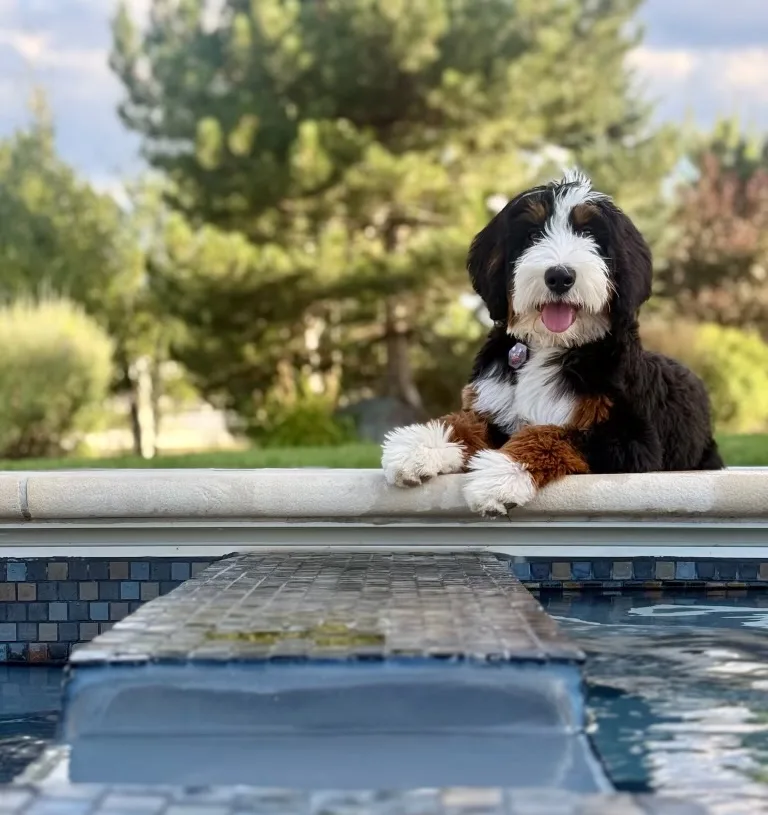
The Bernedoodle is a well-balanced, substantial yet athletic companion dog developed from Bernese Mountain Dog and Poodle ancestry.
The ideal Bernedoodle combines the strength, substance, steadiness, gentle expression and recognizable type associated with the Bernese Mountain Dog with the intelligence, trainability, athleticism, adaptability and coat characteristics contributed through Poodle ancestry.
The Bernedoodle should not represent a simple visual midpoint between the two foundation breeds.
The preferred Bernedoodle should retain clear Bernese influence in overall substance, head, expression, body, proportion and marking distribution while incorporating the athletic ability, intelligence, coat variation and size diversity contributed through Poodle ancestry.
Regardless of size, the Bernedoodle should present a harmonious outline with good bone, sufficient body, a strong topline, balanced angulation and free, efficient movement.
The Bernedoodle should never appear excessively fine, narrow, fragile or lacking in substance. Excessively Poodle-like refinement, extreme legginess, a long narrow head, or a strongly curled Poodle-type coat are undesirable.
At the same time, the Bernedoodle should remain athletic and functional. Excessive heaviness, poor conditioning or any physical exaggeration that interferes with normal movement is undesirable.
The distinguishing characteristics of the Bernedoodle include:
- Stable and affectionate temperament
- Substantial yet athletic construction
- Soft and expressive appearance
- Natural tail
- Bernese-influenced coloring and markings
- Straight to loose-wavy coat
- Intelligence and trainability
- Strong family-companion temperament
Above all, a Bernedoodle should be sound, confident, adaptable and capable of participating comfortably in normal family, sporting and outdoor activities.
Temperament, health, structure, soundness and movement take precedence over cosmetic characteristics.
However, preservation of a recognizable and intentional Bernedoodle phenotype is an important objective of the standard.
Bernedoodle Type
The ideal Bernedoodle should retain recognizable Bernese influence in substance, head, expression, body shape and marking distribution.
The dog should possess greater substance and breadth than a refined Poodle while retaining sufficient athleticism for free, efficient movement.
The preferred silhouette is sturdy, balanced and moderately substantial rather than narrow, delicate or excessively refined.
The ideal head should show clear Bernese influence while remaining proportionate to the overall dog.
A long, narrow, finely chiseled Poodle-like head is undesirable.
The coat should preferably be straight or loose-wavy rather than tightly curled.
The overall appearance should immediately suggest Bernedoodle type rather than simply appearing to be a Poodle with different markings or a Bernese Mountain Dog with an altered coat.
Size, Proportion and Substance
Size
Bernedoodles occur across a broad range of sizes.
Size diversity is an established characteristic of the Bernedoodle and results from the size range present within Poodle ancestry as well as the intentional use of different-sized Bernedoodles within responsible breeding programs.
The following classifications are based primarily upon expected mature weight.
They are intended as practical and descriptive classifications rather than rigid genetic divisions.
Some overlap between categories is normal and expected.
Micro Mini
Typical mature weight: under 20 pounds
There is no prescribed minimum weight or height for a Micro Mini Bernedoodle.
The Micro Mini should retain appropriate Bernedoodle proportion, bone, substance, soundness and overall type despite its smaller stature.
Small size alone is not a fault provided the dog remains structurally sound and proportionate.
Extreme fragility, excessively fine bone, disproportionately shortened limbs or structural abnormalities associated with extreme miniaturization are undesirable.
Petite Mini
Typical mature weight: approximately 20 to 30 pounds
The Petite Mini should possess sufficient bone and substance for its size and should retain the balanced proportions, expression and overall character expected of the Bernedoodle.
Mini
Typical mature weight: approximately 30 to 50 pounds
The Mini Bernedoodle should be substantial and athletic for its size without appearing excessively refined, fragile or low to the ground.
Medium
Typical mature weight: approximately 40 to 60 pounds
The Medium Bernedoodle should combine substantial bone and body with athleticism and balanced proportions.
Natural overlap between the Mini and Medium classifications is expected.
Standard
Typical mature weight: approximately 60 to 90 pounds
The Standard Bernedoodle should be powerful, substantial and well developed while remaining athletic, balanced and capable of free movement.
Standard XL
Typical mature weight: 90 pounds and above
The Standard XL Bernedoodle represents the upper end of the Bernedoodle size range.
Greater size should be accompanied by corresponding frame, bone and musculature.
Size alone should never be rewarded at the expense of soundness, movement, balance or health.
Size Classification Considerations
There is intentionally some flexibility and overlap between Bernedoodle size classifications.
Different size categories may be bred together when appropriate to maintain or improve:
- Genetic diversity
- Temperament
- Structure
- Health
- Coat
- Overall breed type
- Desired size range
As a result, mature offspring from a pairing may occasionally fall into a neighboring size category.
Adult weight is influenced by height, frame, bone, sex, parental size, Bernese percentage, body condition and individual development.
For these reasons, size classifications should be regarded as approximate descriptors rather than absolute genetic boundaries.
A dog should not be considered incorrect solely because its mature weight falls slightly outside the expected range for its anticipated category.
Overall quality, temperament, health and structural soundness are substantially more important than exact placement within a size designation.
Proportion
The Bernedoodle is nearly square to slightly rectangular in outline.
A slightly longer-than-tall dog is preferred, although an essentially square dog is acceptable.
The distance from the point of shoulder to the point of buttock should be approximately equal to, or slightly greater than, the height at the withers.
The dog should never appear markedly long and low.
Excessively tall, narrow or leggy construction is also undesirable.
The distance from the elbow to the ground should approximate one-half of the height at the withers.
The chest should extend approximately to the elbow.
Sufficient body length should be present to permit an unrestricted and efficient stride.
Excessive length through the loin is undesirable.
Substance
Bone and substance should be appropriate to the size and overall frame of the individual dog.
The Bernedoodle should convey strength and substance without sacrificing athleticism.
Light, narrow, weak-boned or weedy individuals are undesirable.
Bone should be strong and clearly present without interfering with efficient movement.
Males may demonstrate greater bone, head and overall substance than females.
Sexual dimorphism is desirable.
Males should generally appear masculine without coarseness.
Females should generally appear feminine while maintaining adequate substance and breed type.
Condition
The Bernedoodle should be presented in healthy, fit condition.
The dog should be well muscled and neither excessively thin nor carrying excessive body fat.
Condition should allow the dog's natural structure, movement and athletic ability to be clearly evaluated.
Head
The head is an important component of Bernedoodle type and expression.
It should be proportionate to the body and should convey intelligence, kindness, softness and confidence.
The ideal head should show clear Bernese influence without becoming excessively heavy or coarse.
A long, narrow, highly refined or sharply chiseled Poodle-like head is undesirable.
Skull
The skull should be moderately broad and well developed.
The top of the skull should appear relatively flat to gently rounded.
A slight median furrow may be present.
The stop should be clearly defined but not exaggerated.
The cheeks should be clean to moderately developed.
The skull should possess sufficient width to create a soft, substantial and characteristic expression.
Muzzle
The muzzle should be broad, strong, straight and of moderate length.
It should neither be long, thin and snipy nor extremely short.
The muzzle should blend smoothly into the skull.
The jaws should possess sufficient width and strength to give the head balance.
Lips and Flews
The lips should be clean and reasonably close fitting.
Slight development of the flews is acceptable.
Excessively loose, pendulous or wet lips are undesirable.
Nose
The nose should be broad with well-developed nostrils.
Pigment should correspond appropriately with the dog's underlying color.
Black pigment is expected in black-based dogs.
Brown or liver pigment is appropriate in chocolate-based dogs.
Bite
A scissors bite is preferred.
A level bite is acceptable.
Full dentition is preferred.
Significant undershot or overshot bites, severely misaligned jaws or abnormalities affecting comfort or function are serious faults.
Eyes
The eyes are an important component of Bernedoodle expression.
They should convey a soft, intelligent, affectionate and confident appearance.
The eyes should be medium in size, slightly oval and set well apart.
They should be neither excessively prominent nor deeply set.
Round, protruding or unusually small eyes are undesirable.
The eyelids should fit closely.
Entropion or ectropion is a serious fault.
Eye Color
The following eye colors are permissible:
- Brown
- Blue
- Green
- Hazel
Variations within these colors are acceptable.
Different-colored eyes or variation in pigmentation associated with merle coloring are permissible and should not, by themselves, be considered faults.
Expression, placement and overall harmony of the eye with the head are more important than eye color.
Ears
The ears should be drop ears of moderate size.
They should be set near the side of the skull, approximately at or slightly above eye level.
The ears should frame the face naturally without appearing excessively long, heavy or exaggerated.
Neck
The neck should be of moderate length, muscular and well integrated into the shoulders.
It should permit natural head carriage and unrestricted movement.
An excessively short and thick neck or an excessively long and weak neck is undesirable.
Topline
The topline should be strong and generally level from the withers through the back while standing and moving.
The loin should be strong and sufficiently broad to support athletic movement.
A persistently weak, sagging, roached or unstable topline is undesirable.
The topline should remain relatively stable during movement.
Body
The body should demonstrate depth, strength and substance.
The chest should reach approximately to the elbow.
The chest should possess sufficient width and depth without interfering with free forelimb movement.
The ribs should be well sprung without producing an excessively barrel-shaped body.
The forechest should be apparent without exaggeration.
The loin should be strong and relatively compact.
There should be moderate tuck-up appropriate to the individual dog's construction.
The body should never appear slab-sided, narrow, weak or lacking in depth.
Croup
The croup should be broad, strong and smoothly rounded.
It should flow naturally into the tail set without abrupt slope or excessive steepness.
The croup should contribute to efficient rear movement and a balanced overall outline.
Tail
The tail is natural and forms an important part of Bernedoodle balance and expression.
The tail bones should generally reach approximately to the hock or slightly beyond.
At rest, the tail may hang naturally with a slight curve.
When alert, excited or moving, the tail may be carried above the topline in a natural curve.
A loosely carried tail above the topline is acceptable.
A tightly curled tail carried flat against the back is undesirable.
A kinked or structurally abnormal tail is a fault and should be evaluated according to severity.
The natural tail should not be cosmetically docked or substantially shortened.
Forequarters
The forequarters should be muscular, strong and balanced with the hindquarters.
Shoulders
The shoulder blades should be long enough and sufficiently laid back to permit efficient forward reach.
The upper arm should be of adequate length to position the front legs properly beneath the body.
An excessively upright shoulder or short upper arm that substantially restricts movement is undesirable.
Front Legs
Viewed from the front, the forelegs should be straight and appropriately spaced.
Bone should be strong and proportionate to the individual dog.
Viewed from the side, the legs should be positioned appropriately beneath the body.
The elbows should remain reasonably close to the body.
Elbows turning markedly inward or outward are undesirable.
Pasterns should be strong, relatively short and possess a slight natural slope.
Feet
The feet should be strong, compact and well padded.
Round to moderately oval feet are preferred.
The toes should be well arched and supported by thick, well-developed pads.
Weak, flat, severely splayed or elongated hare-like feet are undesirable.
Dewclaws may be retained and are not considered a fault.
Hindquarters
The hindquarters should be broad, muscular, powerful and appropriately angulated in balance with the forequarters.
The thighs should be strong and well developed.
The stifles should demonstrate moderate functional angulation.
The hocks should be strong, stable and reasonably well let down.
Viewed from behind, the hind legs should move reasonably straight and parallel.
Marked cow hocks, spread hocks, sickle hocks, unstable hocks or structural abnormalities interfering with movement should be penalized according to severity.
Rear angulation should balance the front assembly.
Excessive rear angulation that produces instability or imbalance is undesirable.
Coat
Coat type is an important component of the desired Bernedoodle phenotype.
The preferred Bernedoodle coat is straight to loose-wavy.
The long-term goal is to maintain a soft, attractive and manageable coat while reducing excessive Poodle-like curl.
Preferred Coat
A straight or very loose coat is preferred.
The coat may possess body, softness, furnishings and natural movement without forming tight curls.
Acceptable Coat
A loose to moderately wavy coat is also acceptable and desirable.
Wave may vary in intensity throughout the body.
The overall appearance should remain soft and natural rather than tightly curled.
Less Preferred Coat
A distinctly curly or strongly Poodle-like coat may occur within the Bernedoodle population.
However, strong curl is less representative of the preferred Bernedoodle phenotype.
The long-term direction of the standard is to breed away from strongly curly Poodle-type coats in favor of straight and loose-wavy coats.
A curly coat alone does not make an otherwise healthy and well-structured dog unsuitable as a companion.
However, in selection toward ideal Bernedoodle type, straight and loose-wavy coats are preferred.
No amount of coat should obscure poor structure.
Coat should never be rewarded at the expense of temperament, health, movement or overall conformation.
Furnishings
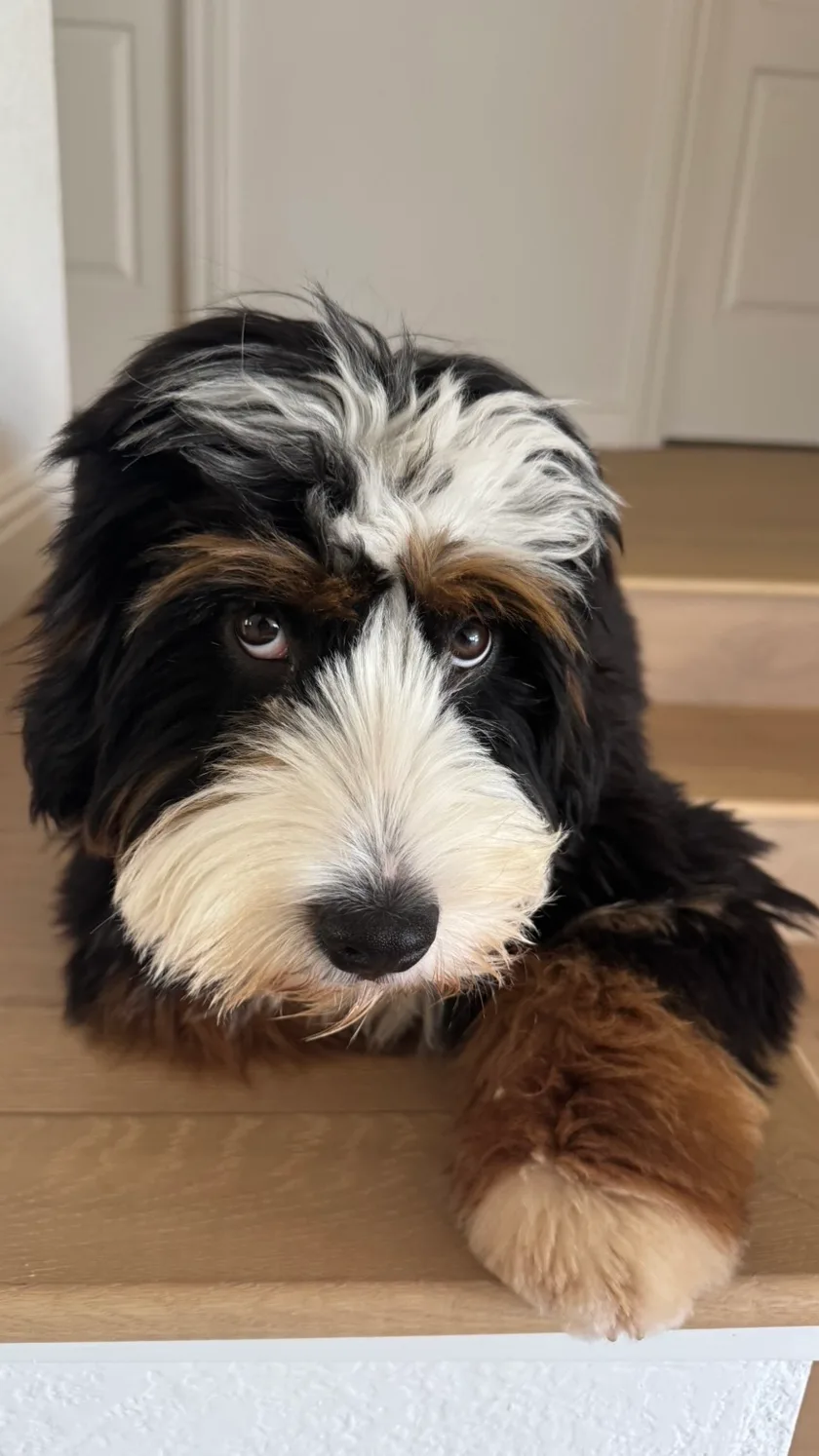
Furnishings may be present on the muzzle, brows and face and are characteristic of many Bernedoodles.
The presence and quality of furnishings may contribute to recognizable Bernedoodle expression.
However, furnishings should not be permitted to obscure the structure of the head.
Breeding Coat Genetics
For breeding and genetic selection purposes, programs may separately track curl genotype.
The preferred long-term direction is toward:
No curl: -/-
and
Wavy: +/-
Dogs expressing strong curl associated with +/+ may occur but are less consistent with the preferred phenotype.
Genetic information should be used as a breeding tool and should not replace evaluation of the actual mature coat and overall dog.
Color and Markings
Color and markings are important components of recognizable Bernedoodle type.
The preferred and recognized colors and patterns are:
- Traditional Tricolor
- Chocolate Tricolor
- Merle Tricolor
- Chocolate Merle Tricolor
- Sable
- Red and White
Color should never compensate for poor temperament, structure, health or movement.
Traditional Tricolor
Traditional Tricolor consists of a predominantly black base with clearly defined white markings and rich tan or rust points.
The overall distribution should resemble classic Bernese Mountain Dog coloring as closely as reasonably possible.
Chocolate Tricolor
Chocolate Tricolor follows the same general pattern as Traditional Tricolor, with brown or chocolate replacing black.
White markings and rich tan or rust points should remain clearly defined.
Pigment should appropriately correspond with the chocolate base color.
Merle Tricolor
Merle Tricolor should retain recognizable tricolor patterning, with merling occurring throughout the areas that would otherwise be black.
The pattern should ideally retain clearly identifiable white markings and rich tan or rust points.
Chocolate Merle Tricolor
Chocolate Merle Tricolor should retain recognizable chocolate-tricolor patterning, with merling occurring throughout the areas that would otherwise be chocolate.
Appropriate white markings and intense tan or rust points are desired.
Sable
Sable may vary in intensity and distribution.
The pattern should remain attractive, balanced and harmonious with the overall Bernedoodle phenotype.
White markings are desirable when distributed in a Bernese-inspired pattern.
Red and White
Red and White dogs should possess a rich, attractive red base color with clean white markings.
Where possible, white distribution should resemble the balanced Irish white pattern preferred throughout the standard.
Preferred Marking Pattern
In colors and patterns where the genetics permit, markings should approximate traditional Bernese Mountain Dog markings and Bernese-style Irish white spotting as closely as reasonably possible.
The ideal distribution of white may include:
- A distinct facial blaze
- White on or around the muzzle
- A prominent white chest
- White on the feet
- White extending upward on the lower legs
- White at the tail tip where genetically present
The chest marking should ideally be substantial, balanced and visually consistent with classic Bernese-type white distribution.
Markings should appear balanced and harmonious.
Correct distribution and overall balance are more important than mathematically perfect symmetry.
Perfect symmetry is not required.
Excessively irregular markings or markings substantially removed from the desired Bernese-inspired pattern may be considered less desirable from a type perspective but should never outweigh major structural or temperamental qualities.
Tan and Rust Points
Where genetically present, tan or rust points should be as rich, saturated and intense as possible.
Deep rust, copper or strongly saturated tan is preferred.
Pale, cream-colored, washed-out or indistinct tan points are less desirable.
Points should be clearly defined and ideally distributed in a manner similar to the Bernese Mountain Dog.
Preferred locations include:
- Above the eyes
- On the cheeks
- Along the sides of the muzzle
- On the sides of the chest
- On the legs
- Beneath the tail
Intensity and definition of tan or rust points are important aesthetic characteristics of the preferred Bernedoodle phenotype.
Movement
Movement should be free, balanced, coordinated and apparently effortless.
The Bernedoodle should demonstrate good forward reach and strong, controlled rear drive.
Power generated by the hindquarters should be transmitted through a stable topline with minimal wasted action.
Viewed from the front, the forelegs should travel in generally straight lines without excessive paddling, winging or elbowing.
Viewed from behind, the hindquarters should provide strong and controlled propulsion.
The hocks should remain stable and should not turn excessively inward or outward.
Viewed from the side, the forequarters should demonstrate good forward reach while the hindquarters provide effective drive.
The topline should remain relatively stable while moving.
As speed increases, the legs may naturally converge toward the center line.
Short, choppy movement, excessive high-stepping action, persistent pacing, crossing, side-winding, paddling or other gait abnormalities interfering with efficient movement are faults.
Exaggerated hackney-like movement is undesirable.
Movement should demonstrate efficiency, balance and soundness rather than theatrical exaggeration.
Temperament
Temperament is one of the defining characteristics of the Bernedoodle and should receive considerable weight in evaluation and breeding decisions.
The ideal Bernedoodle is:
- Affectionate
- Confident
- Gentle
- Intelligent
- Social
- Adaptable
- Trainable
- Engaged with people
- Curious without being excessively reactive
The dog should demonstrate sufficient confidence to recover readily from unfamiliar sights, sounds, people and environments.
A mature Bernedoodle should not demonstrate persistent fearfulness, uncontrollable anxiety or inappropriate aggression.
Some reserve with unfamiliar people is acceptable, particularly in dogs expressing stronger Bernese characteristics, provided the dog remains stable, manageable and capable of normal interaction.
Unprovoked aggression toward people is unacceptable.
Extreme or persistent shyness in a mature dog is a serious fault.
Temperament deficiencies should never be excused because of exceptional coloring, markings, coat, size or appearance.
Natural Presentation and Grooming
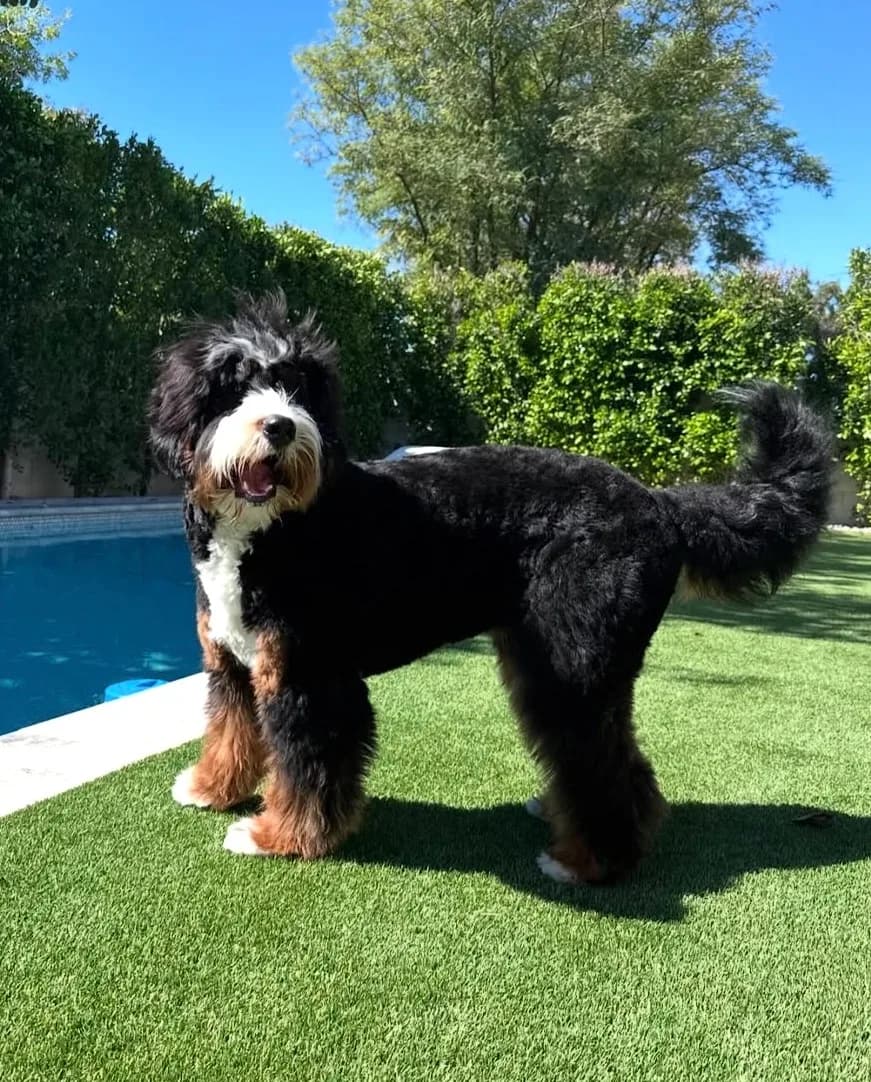
The Bernedoodle should be presented in a manner that allows its natural structure and coat to be evaluated.
Moderate grooming to maintain cleanliness, condition and a tidy appearance is acceptable.
Excessive sculpting, trimming or styling designed to fundamentally alter the dog's natural outline is undesirable.
The dog should not be groomed in a manner that creates an exaggerated Poodle-like silhouette or conceals structural faults.
Natural expression, coat movement and body outline should remain visible.
Faults
A fault is any departure from the foregoing standard and should be evaluated according to the degree to which it affects health, soundness, temperament, movement or recognizable Bernedoodle type.
Particular concern should be given to:
- Excessive fragility
- Insufficient bone or substance
- Disproportionate construction
- Poor front or rear assembly
- Unstable joints
- Weak topline
- Severe structural imbalance
- Movement abnormalities
- Extremely narrow or weak heads
- Excessively Poodle-like refinement
- Severe bite abnormalities
- Persistent fearfulness
- Inappropriate aggression
- Physical exaggerations that interfere with normal function
From a breed-type and aesthetic perspective, the following are less desirable:
- Strongly Poodle-like curly coats
- Excessively narrow or finely chiseled heads
- Excessive legginess
- Pale or weak tan points
- Poorly defined tan points
- Markings substantially removed from the desired Bernese-inspired pattern
- Lack of sufficient substance
- Excessive Poodle-like overall appearance
Structural and temperament deficiencies remain substantially more serious than cosmetic deviations.
Serious Faults
The following should be considered serious faults:
- Persistent temperament instability
- Extreme shyness in a mature dog
- Structural abnormalities materially interfering with normal movement
- Severe overshot or undershot bite
- Severe disproportion associated with extreme miniaturization
- Severe lack of bone or substance
- Chronic or visibly unstable joints
- Entropion
- Ectropion
- Extreme cow hocks
- Severe rear instability
- Severely upright front assembly restricting movement
- Extreme imbalance between front and rear construction
- Severely unstable topline
- Any physical exaggeration materially compromising normal function
Disqualifications
The following are disqualifications:
- Unprovoked aggression toward a person.
- Extreme temperament instability rendering the dog incapable of normal examination or handling.
- Deliberate docking or substantial shortening of the natural tail for cosmetic purposes.
- A structural deformity materially incompatible with normal, comfortable movement.
Variations in eye color, minor deviations in markings, mature weight outside an anticipated size category or coat texture alone should not constitute grounds for disqualification.
Scale of Points
When evaluating the Bernedoodle as a complete dog, the following approximate weighting is recommended:
| Category | Points |
|---|---|
| Temperament, general appearance and breed type | 25 |
| Structure, proportion and substance | 25 |
| Movement | 20 |
| Head and expression | 15 |
| Coat | 8 |
| Color and markings | 7 |
| Total | 100 |
Color and markings deliberately represent a relatively small percentage of the total score.
A dog with exceptional coloring or markings should never prevail over a dog possessing superior temperament, structure, soundness and movement solely because of cosmetic appearance.
Guiding Principle
The Bernedoodle should always be judged as a complete dog.
Temperament, health, structural soundness, balance and movement take precedence over cosmetic characteristics.
At the same time, a meaningful breed standard should establish a recognizable and intentional phenotype.
The preferred Bernedoodle therefore combines:
Substantial Bernese-influenced structure and expression; a strong yet athletic body; rich and clearly defined coloring; traditional Bernese-inspired markings; intense tan or rust points; a straight to loose-wavy coat; balanced and efficient movement; intelligence; trainability; and an affectionate, stable family-companion temperament.
The goal is not to produce a smaller or differently colored Poodle.
The goal is also not simply to reproduce a Bernese Mountain Dog with an altered coat.
The goal is to establish a consistent Bernedoodle phenotype that is immediately recognizable in its own right while preserving and refining the most desirable characteristics contributed by its foundation breeds.