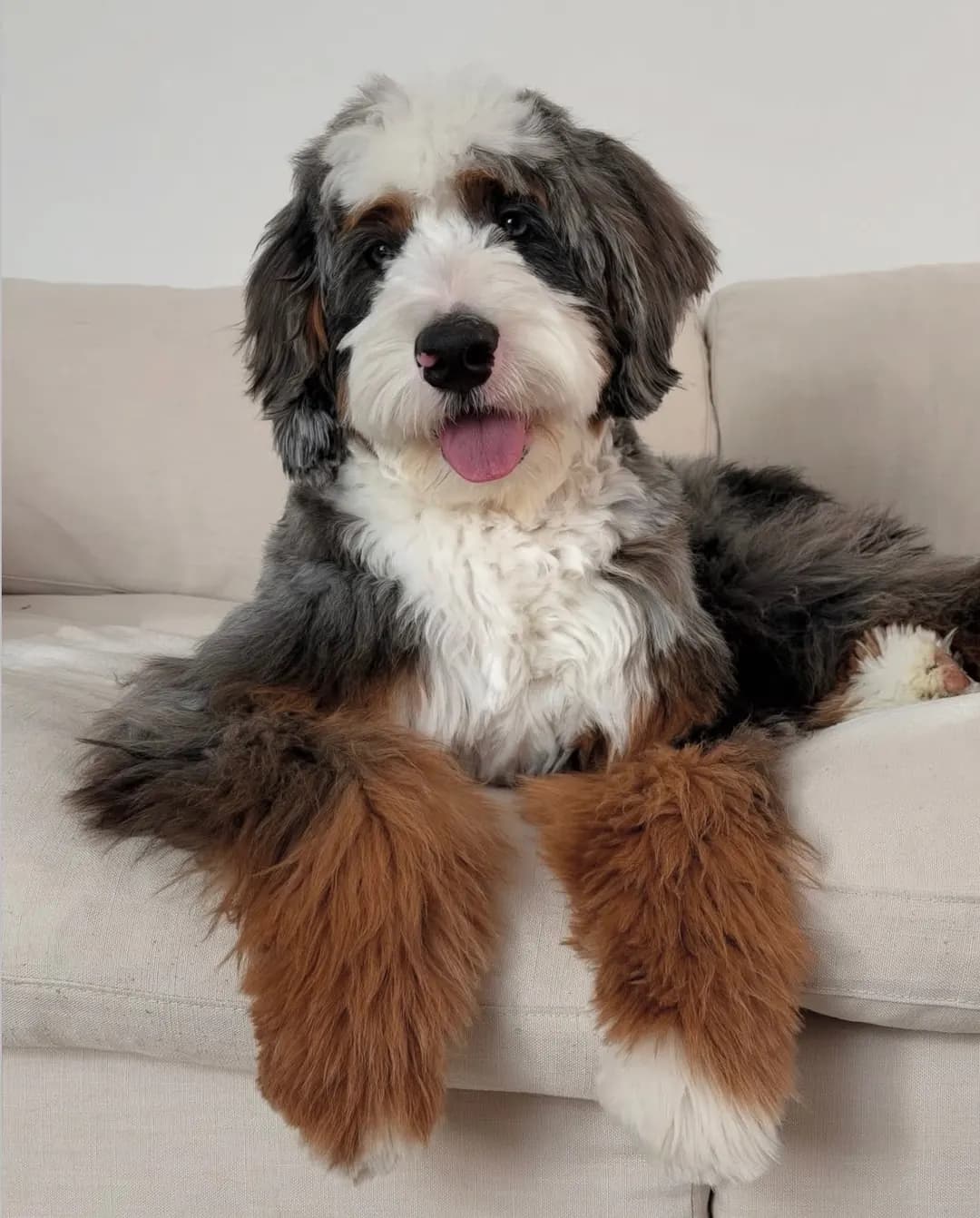
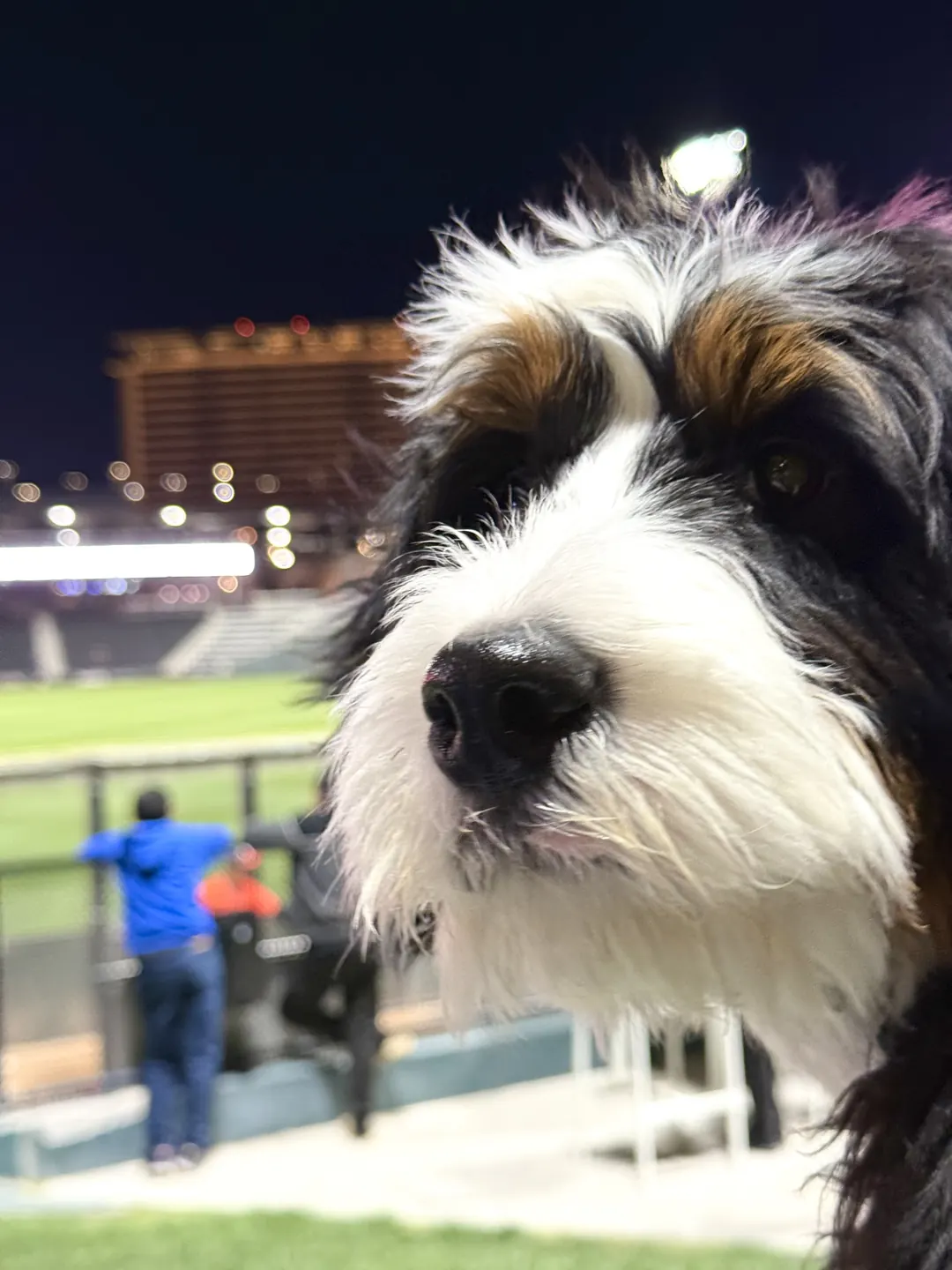
Furnishings are among the most recognizable features of a Bernedoodle. They are the longer hair that forms the eyebrows, mustache, beard, and characteristic facial framing associated with Poodles and many Poodle-derived dogs. A furnished Bernedoodle generally looks softer and more “teddy bear-like,” while an unfurnished Bernedoodle has a smoother face that more closely reveals its Bernese Mountain Dog ancestry.
Today, a DNA test can identify an important genetic variant associated with furnishings. That test is enormously useful. But it has also encouraged an oversimplified idea: that a furnishings result tells us everything we need to know about the strength, density, development, or ultimate appearance of a dog’s facial coat.
It does not.
The most accurate way to understand furnishings is to combine three forms of information:
- Genotype: Which RSPO2 variants did the dog inherit?
- Phenotype: How are those variants actually expressed in the dog’s face and coat?
- Family and progeny information: What do the dog’s relatives and offspring consistently produce?
This distinction becomes especially important in Bernedoodles because one parent may be a fully furnished Poodle or furnished multigenerational Bernedoodle while the other is an unfurnished Bernese Mountain Dog. In that type of mating, the strength and behavior of the furnishing allele contributed by the furnished parent can become much more visible.
What are furnishings?
In canine coat terminology, furnishings refer primarily to increased hair growth around the muzzle and above the eyes. Phenotypically, that means some combination of:
- pronounced eyebrows;
- a mustache across the sides and front of the muzzle;
- a beard or longer hair beneath the chin;
- increased facial framing around the cheeks;
- greater hair growth on the lower legs and feet.
Furnishings are not the same as curl. They are not the same as coat length. They are also not, by themselves, a guarantee that a dog will never shed.
A dog can be furnished and straight coated. It can be furnished and wavy. It can be furnished and curly. Those differences reflect the combined action of multiple coat genes and the dog’s broader genetic background.
The three best-established major coat loci are:
- RSPO2, which strongly influences the facial growth pattern known as furnishings;
- FGF5, which is a major determinant of coat length;
- KRT71, which influences curl. [1,10,11]
Additional genes, including MC5R, can influence shedding. Other known and unknown modifiers may affect coat density, texture, undercoat, maturation, and the degree to which a particular furnishing genotype is visibly expressed. [7,8]
This is why two dogs with the same simplified RSPO2 result do not necessarily have identical faces or coats.
What does RSPO2 do?
RSPO2 encodes R-spondin-2, a protein involved in Wnt signaling and hair-follicle development. In 2009, researchers studying more than 1,000 dogs from 80 breeds identified a 167-base-pair insertion in the 3-prime untranslated region of RSPO2 that was strongly associated with the furnished growth pattern. [1]
The variant does not alter the protein-coding sequence itself. Instead, it changes regulation of the gene. The researchers found approximately threefold higher RSPO2 transcript levels in muzzle skin from furnished dogs. [1]
In that study, 297 of 298 furnished dogs carried at least one copy of the insertion, while all 406 dogs without furnishings were homozygous for the ancestral state. That is compelling evidence that the principal RSPO2 insertion has a major and generally dominant effect on whether furnishings are present. [1]
Subsequent research in Portuguese Water Dogs showed the same biological distinction from the opposite direction. Dogs lacking the dominant RSPO2 insertion could develop what that breed calls an “improper coat”: shorter hair on the head, face, and lower legs rather than the expected evenly furnished coat. [2]
For Bernedoodles, “unfurnished” is usually the clearer and less judgmental term. An unfurnished dog is not unhealthy or genetically defective. It simply lacks the facial coat pattern desired in many Bernedoodle programs.
Furnishing tests do not all test or report the same thing
One reason for confusion is that laboratories use different letters and sometimes different interpretations for the same region.
Depending on the laboratory, the principal furnished allele may be written as F, W, or N. The unfurnished or improper-coat allele may be written as f, IC, I, or another laboratory-specific symbol. An N/N result can even mean different things depending on whether the report is framed as a furnishings test or an improper-coat test.
The letters should never be interpreted without reading the laboratory’s own legend.
There is a second and more important difference. Many standard RSPO2 tests distinguish the well-established 167-base-pair furnishings insertion from the ancestral, non-furnishing state. Some commercial laboratories also offer a third result that they call weak furnishings, often written as Fw or F2.
Paw Print Genetics describes a three-allele hierarchy: [4]
full furnishings > weak furnishings > unfurnished/improper coat
Animal Genetics likewise reports a second furnishings-associated result as F2 and states that dogs carrying F2 may display furnishings to a lesser degree. [5]
These reports can be useful. However, an important evidence distinction should be made. The principal 167-base-pair RSPO2 insertion is supported by peer-reviewed association, expression, segregation, and improper-coat studies. The publicly available laboratory pages for Fw/F2 cite the foundational RSPO2 paper, but that paper does not describe and validate a separate weak-furnishings allele. We could not identify a published, independently replicated study that defines the commercial Fw/F2 variant, provides its sequence, and quantifies its penetrance or degree of expression across Bernedoodles.
That does not prove the laboratory result is invalid. It means the evidence available to the public is not as complete as it is for the principal furnishings insertion.
Accordingly, a careful program should record:
- the laboratory used;
- the exact genotype and notation reported;
- which RSPO2 variants that test actually interrogates;
- the dog’s observed phenotype;
- the phenotypes of relevant siblings and offspring.
- “Tested for furnishings” is not sufficiently specific unless we know what was tested.
Three levels of evidence should not be blended together
The word genetic can make every laboratory statement sound equally established. In reality, coat information may rest on different levels of evidence:
| Level of evidence | What it can establish | Furnishings example |
|---|---|---|
| Peer-reviewed association and segregation | A variant repeatedly tracks with a phenotype in a defined study population | The principal 167-bp RSPO2 insertion and the presence of furnishings [1,2] |
| Functional or expression evidence | The variant affects gene regulation, protein function, or a biological pathway | Increased RSPO2 transcript levels in furnished muzzle skin [1] |
| Commercial laboratory interpretation | A laboratory reports an additional variant based on its internal validation | Fw or F2 weak-furnishings classifications [4,5] |
All three can be useful, but they should not be presented as interchangeable. A commercial result may be valuable for planning matings even when the complete discovery dataset, variant sequence, penetrance estimates, or independent replication have not been published. The proper response is not to dismiss the result; it is to label the strength and source of the evidence accurately.
Two different meanings of “weak furnishings”
The phrase weak furnishings is frequently used as though it describes one single genetic category. In practice, it is used in at least two different ways.
1. Test-detected weak furnishings
Some laboratories report a specific weak-furnishings result, labeled Fw or F2. Under the laboratory’s model, this allele is weaker than the full furnishings allele but dominant to the unfurnished state.
For example, a dog reported as F/Fw may appear fully furnished because the full allele masks the weaker allele. When bred to an unfurnished dog, however, approximately half of the puppies are expected to inherit Fw with the unfurnished allele and may display weaker furnishings.
This is the type of weak furnishing that a laboratory specifically claims to detect.
2. Phenotypically weak furnishings not explained by the test
Breeders also encounter dogs that test as carrying the conventional furnishings insertion, or test negative for a laboratory’s reported weak variant, yet develop visibly sparse, delayed, uneven, or minimal furnishings.
This is sometimes called “untestable weak furnishings.” A more scientifically precise phrase would be:
A weak furnishing phenotype not explained by the variants included in the test.
A negative result for a known weak allele does not prove that every other genetic cause of weak expression has been excluded. Commercial DNA tests examine selected variants. They do not sequence and functionally interpret every regulatory element influencing RSPO2, every interacting coat gene, or every unknown modifier in the genome.
Several explanations may contribute to a weak phenotype despite a conventional result:
- an untested regulatory variant in or near RSPO2;
- another coat gene or modifier altering the visibility of the furnishings;
- interactions among RSPO2, FGF5, KRT71, MC5R, and the broader genetic background;
- age-dependent coat development;
- differences in overall facial hair length or density;
- grooming, clipping, breakage, nutrition, illness, or other non-genetic influences;
- classification error when a very young puppy is evaluated from photographs.
Research in other dogs has demonstrated that RSPO2 can interact with FGF5 and influence overall hair length differently depending on genetic background. FGF5 itself is a major determinant of canine coat length, and multiple KRT71 variants can produce curly phenotypes. [6,10,11] The discovery of additional KRT71 alleles is not evidence for an undiscovered RSPO2 allele in any particular Bernedoodle; it is an instructive precedent showing why a negative result on a finite variant panel cannot exclude every genetic route to a similar-looking coat.
This is why a laboratory result and a phenotypic observation can disagree without either one being meaningless. They are measuring different things.
Genotype answers one question; phenotype answers another
A genotype asks:
Which tested alleles did this dog inherit?
A phenotype asks:
What coat did this dog actually develop?
The genotype can help predict inheritance. The phenotype shows the outcome of the tested alleles interacting with the rest of the genome, development, and environment.
For a simple presence-or-absence question, the principal RSPO2 test is highly informative. A dog with no recognized furnishings variant is unlikely to develop the classic furnished phenotype. A dog with at least one copy of the well-established insertion is expected to be furnished.
But the binary result does not fully answer:
- how early the furnishings will become obvious;
- how dense the eyebrows will be;
- how much hair will cover the bridge and sides of the muzzle;
- whether the beard will be full or sparse;
- whether the furnished areas will be straight, wavy, or curly;
- how the furnishings will look after coat change;
- how strongly the dog will reproduce those characteristics when bred to an unfurnished mate.
Those are phenotypic and family-level questions.
What should a phenotypic furnishing evaluation examine?
There is currently no universally validated scientific scoring system for furnishing strength in Bernedoodles. A program can still make its observations more consistent by using the same landmarks, ages, photographic conditions, and definitions across dogs.
A practical phenotypic evaluation should examine:
Eyebrows
Are there distinct longer hairs above the eyes? Are the eyebrows dense and continuous, or limited to a few fine hairs near the inner corners?
Muzzle and mustache
Does longer hair clearly project from the sides and front of the muzzle? Is there coverage across the muzzle, or does the short underlying facial coat remain dominant?
Beard and chin
Is there obvious length beneath the lower jaw? Is the beard dense, sparse, or absent?
Facial transition
How smoothly does the furnished muzzle connect to the cheeks and surrounding facial coat? A strongly furnished dog usually has a more continuous frame rather than isolated wisps.
Legs and feet
RSPO2-associated furnishings can include increased growth on the lower legs. Toe and leg coverage may provide supporting information, although grooming and the effects of other coat genes must be considered.
Density, not merely length
A few very long hairs do not necessarily equal strong furnishings. Density, distribution, and continuity matter as much as maximum hair length.
Development across time
A young puppy should not be judged by an adult standard. Furnishings may develop gradually, and coat change can alter their appearance. Useful records include standardized, untrimmed photographs at approximately 8 weeks, 12 to 16 weeks, 6 months, and again after the adult coat is established.
Those ages are practical observation points, not scientifically validated diagnostic cutoffs. Comparisons should be made among puppies of similar age, under similar grooming and photographic conditions.
A simple internal scale can improve consistency:
| Phenotypic category | Working description |
|---|---|
| Unfurnished | Smooth or retriever-like face without a developing eyebrow, mustache, or beard pattern |
| Sparse or weak | Some longer facial hair is present, but eyebrows, muzzle coverage, or beard remain light, delayed, or discontinuous |
| Moderate | Clearly identifiable furnishings with visible eyebrows, mustache, and beard, but less facial density or continuity than the program’s strongest examples |
| Strong | Dense, continuous facial furnishings with pronounced eyebrows, substantial muzzle coverage, and a well-developed beard for the dog’s age and coat type |
This is a breeder-recording framework, not a laboratory diagnosis. Its value comes from applying it consistently and linking it to genotypes, pedigrees, and adult offspring.
The photographs should be kept with the original genotype report rather than summarized later from memory. Whenever possible, the record should also note whether the face was trimmed, whether the dog was changing coats, and whether illness or hormonal changes were present. Standardization does not turn a visual score into a diagnostic test, but it makes comparisons across relatives and generations far more informative.
Why breeding to an unfurnished Bernese Mountain Dog is so revealing
A Bernese Mountain Dog is unfurnished at the principal RSPO2 locus. For a simplified mating model, it contributes an unfurnished allele to every puppy.
That means every puppy’s furnishing outcome depends on which allele it receives from the furnished parent.
The table below uses Paw Print’s three-allele terminology to illustrate the point. Laboratory notations differ, and the Fw model should be interpreted as that laboratory’s commercial model rather than as an independently standardized nomenclature.
| Furnished parent | Bernese parent | Expected puppies at RSPO2 |
|---|---|---|
| F/F | IC/IC | 100% F/IC; expected to be furnished |
| F/Fw | IC/IC | 50% F/IC furnished; 50% Fw/IC expected weakly furnished |
| F/IC | IC/IC | 50% F/IC furnished; 50% IC/IC unfurnished |
| Fw/Fw | IC/IC | 100% Fw/IC; expected weakly furnished |
| Fw/IC | IC/IC | 50% Fw/IC expected weakly furnished; 50% IC/IC unfurnished |
This demonstrates why the phrase “the parent is fully furnished” is not enough.
The percentages in this table are probabilities for each puppy, not a promise about the exact composition of one litter. In a 50:50 mating, every puppy represents a new genetic draw. Six puppies could all inherit the same parental allele even though the probability is only about 1.6%. Therefore, one small litter that happens to contain no weak or unfurnished puppies does not prove that the parent cannot carry the relevant allele. Genotyping and accumulated progeny records are stronger than conclusions drawn from a single litter.
A phenotypically fully furnished dog might be:
- homozygous for the full furnishings allele;
- full-furnished while carrying a laboratory-reported weak allele;
- full-furnished while carrying the unfurnished allele;
- classified as fully furnished by a simplified test that does not interrogate the weak allele offered by another laboratory.
Those dogs may look similar but produce very different outcomes when bred to a Bernese Mountain Dog.
A visually strong parent does not automatically guarantee equally strong offspring
Even an F/F dog with very dense furnishings does not give each puppy both of its furnishing alleles. When bred to an unfurnished Bernese Mountain Dog, every puppy receives one furnishing allele from the furnished parent and one unfurnished allele from the Bernese parent.
One copy of the principal insertion is ordinarily sufficient to create furnishings. But the exact density and development of the offspring’s face can still be influenced by:
- the particular furnishing allele inherited;
- coat length and curl genotypes;
- other modifying genes from both parents;
- overall Poodle and Bernese ancestry;
- developmental variation;
- the broader family phenotype.
For that reason, the best evidence about a furnished parent is not simply that the parent has a beautiful face. It is the combination of:
- a clearly interpreted, sufficiently comprehensive RSPO2 result;
- the parent’s own mature phenotype;
- the phenotypes of siblings and close relatives;
- and, when available, the parent’s F/IC offspring from unfurnished mates.
Progeny information is especially valuable. It shows how the parent’s furnishing allele behaves when paired with the unfurnished background that every Bernese Mountain Dog contributes.
What does “fully furnished” actually mean?
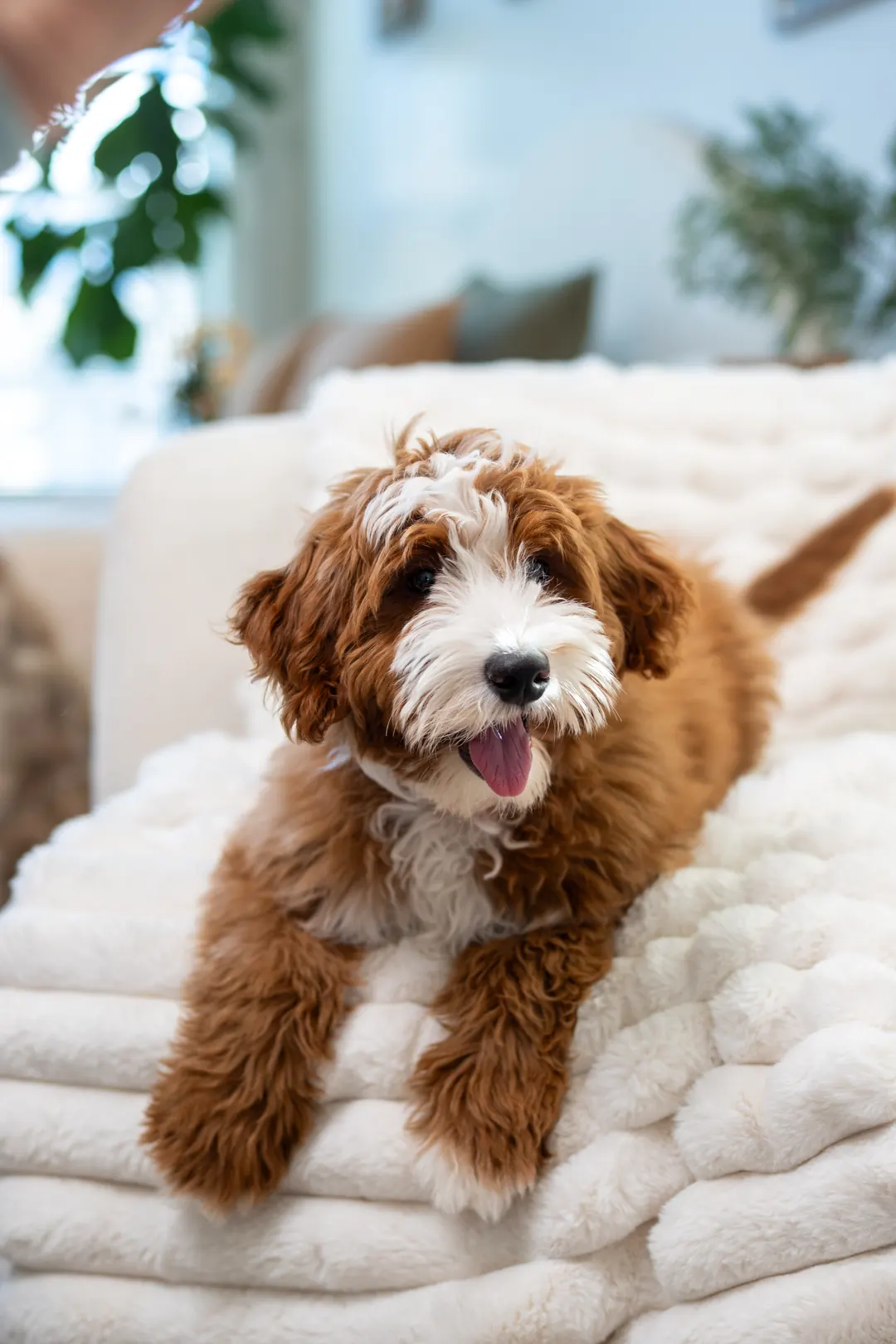
This phrase can describe either genotype or appearance, and those meanings should not be confused.
Genotypically fully furnished
Some breeders use “fully furnished” to mean that a dog has two copies of the principal furnishing allele and will transmit a furnishing allele to every puppy.
Phenotypically fully furnished
Others use it to describe a dog with dense, obvious facial furnishings, regardless of whether the dog is F/F, F/IC, or F/Fw.
A dog can be phenotypically strong while carrying an allele that matters in the next generation. Conversely, a dog may have two copies of a furnishings-associated allele yet display less facial density than another dog because phenotype is influenced by the rest of the coat genome.
Public communication should specify which meaning is intended:
- “homozygous for the tested full-furnishings allele” describes genotype;
- “strongly furnished on phenotypic evaluation” describes appearance.
Neither statement should silently substitute for the other.
Why F/F dogs are generally low to minimally shedding
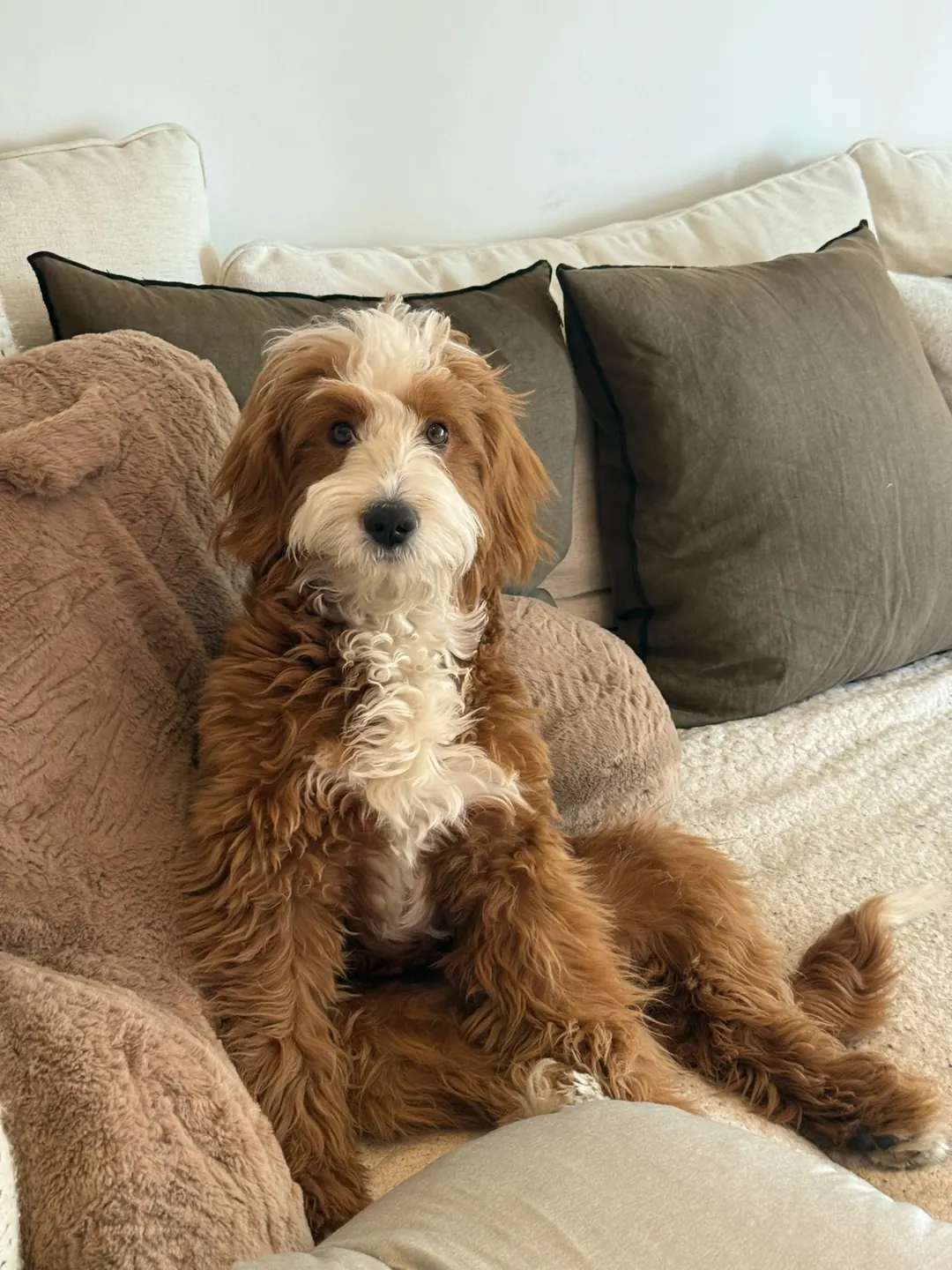
Breeders often observe that dogs reported as F/F-two copies of the principal RSPO2 furnishings allele-are low shedding or appear practically non-shedding in the home. This is not merely folklore. Research comparing coat phenotypes across dog breeds found significant associations between shedding and variants in both RSPO2 and MC5R. Minimal-shedding breeds such as the Poodle and Bichon Frisé are commonly homozygous for the derived RSPO2 furnishings allele. [7,8]
There are two reasons F/F is useful when predicting a Bernedoodle coat.
First, RSPO2 affects more than the presence of a beard. The furnishings insertion changes regulation of a gene involved in Wnt signaling and hair-follicle development. Its most visible effect is the characteristic eyebrow, mustache, beard, and leg growth pattern, but studies also associate the variant with differences in whole-coat growth and shedding. [1,6,7] The precise biological pathway connecting RSPO2 to the release of hair has not been completely defined, so it is more accurate to describe this as a strong genetic association than to claim that the furnishings allele simply “turns shedding off.”
Second, an F/F dog has two copies of the low-shedding-associated RSPO2 variant rather than one furnishing allele paired with the ancestral, unfurnished allele. In the UC Davis Veterinary Genetics Laboratory model, F/F dogs are predicted to fall into a lower shedding category than comparable dogs carrying only one F allele. The strongest prediction occurs when F/F is combined with the favorable MC5R shedding variant. [8]
| RSPO2 result | MC5R result | General shedding interpretation |
|---|---|---|
| F/F | SD/SD or SD/N | Variant combination associated with minimal shedding |
| F/F | N/N | Lower shedding than average is expected, but minimal shedding is not guaranteed |
| F/IC | SD/SD | Reduced shedding relative to average is expected |
| F/IC | SD/N | An intermediate or average result may occur |
| F/IC | N/N | Higher shedding is more likely despite the dog being furnished |
This helps explain why two visibly furnished Bernedoodles can shed differently. One may be F/F and also carry the favorable MC5R background. Another may be F/IC with a less favorable MC5R result and a heavier Bernese-type undercoat. Both have a beard, but they do not have the same genetic prediction for shedding.
In Bernedoodles, F/F can also function as a marker for a broader Poodle-derived coat package. Over generations of selection, the F allele may travel with other coat characteristics that influence length, density, undercoat, texture, and hair retention. This does not mean those characteristics are all caused by RSPO2, and recombination can separate them. Research in Australian Labradoodles illustrates how selection for a Poodle-like coat can increase Poodle-derived ancestry around coat-associated regions and, over generations, across much of the genome. [9] This helps explain why the real-world association between F/F and low shedding can be strong while still producing exceptions.
What “non-shedding” should mean
Biologically, no dog is literally incapable of losing hair. Individual hairs complete a growth cycle, and coat can also be lost through brushing, breakage, coat change, illness, hormonal changes, or seasonal influences. In ordinary family language, non-shedding usually means that very little loose hair is deposited on clothing, furniture, and floors.
For that practical definition, many F/F Bernedoodles-especially those with a favorable MC5R result and a strongly Poodle-influenced coat-may reasonably be described as minimal shedding or functionally non-shedding. The most scientifically responsible wording is still “expected to be low to minimally shedding,” because F/F alone cannot guarantee the result in every dog.
Shedding is influenced by multiple genes, coat density, undercoat, season, hormones, health, grooming, and the interaction between Bernese and Poodle coat backgrounds. A weakly furnished dog may shed more or less than expected. An unfurnished dog is not automatically a heavy shedder in every circumstance, although unfurnished Bernedoodles generally retain more of the Bernese-style shedding pattern.
Furnishings should therefore be described as an important part of coat prediction-not as a test for allergy-friendliness. Low shedding does not mean allergen-free, because people may react to proteins in dander, saliva, and urine as well as material carried on shed hair. Studies measuring the major dog allergen Can f 1 did not find a reliable scientific basis for calling particular breeds “hypoallergenic.” [12,13]
F/F should inform selection, not become the whole selection standard
If every dog that is not F/F is automatically removed from a developing Bernedoodle population, a program may gain predictability at one locus while unnecessarily losing diversity, temperament, structure, health traits, or valuable Bernese ancestry elsewhere in the genome.
An F/IC dog with exceptional health, temperament, structure, pedigree value, and strong phenotypic furnishings may be a more responsible choice than an F/F dog that is inferior in those areas. The F/IC dog simply requires a mating plan that acknowledges its 50% chance of transmitting IC. Conversely, F/F can be extremely valuable when every puppy in a planned mating must inherit the principal furnishing allele-particularly when mating to an unfurnished Bernese Mountain Dog.
The question is therefore not “Is F/F always better?” It is:
What does this genotype contribute to the complete breeding objective, and what genetic diversity or quality might be lost if it becomes an absolute gate?
This is population genetics applied to a visible trait. Selection should improve predictability without allowing a single preferred locus to dominate decisions about the whole dog.
A sound decision process
When furnishings matter to the intended Bernedoodle phenotype, a thoughtful program should ask the following questions before a mating:
- Which exact RSPO2 variants were tested? A basic furnishings test and a three-allele commercial test are not necessarily equivalent. [3-5]
- How does that laboratory label its alleles? Never infer meaning from F, I, IC, N, or W without the report legend.
- What does the dog actually look like at maturity? Record density and distribution, not merely the presence of a few longer hairs.
- Does the phenotype agree with the genotype? If not, investigate age, grooming, laboratory scope, parentage, and possible modifiers rather than forcing the dog into a label.
- What do close relatives look like? Sibling and parent phenotypes can reveal repeatable family tendencies.
- What has the dog produced with an unfurnished mate? This may be the most relevant evidence for a Bernese Mountain Dog cross.
- What other coat loci are present? FGF5, KRT71, MC5R, and other coat information help interpret the complete phenotype. [7,8,10,11]
- Is the mating being selected for the whole dog? Furnishings matter, but health, temperament, structure, longevity, genetic diversity, and compatibility remain more important than a single cosmetic locus.
DNA testing is a tool; coat judgment is still a skill
The RSPO2 test has made Bernedoodle coat planning far more predictable. It allows breeders to reduce the likelihood of unexpected unfurnished puppies and to understand an important component of coat inheritance before a litter is produced.
But genetic testing does not eliminate the need to know what strong furnishings look like.
A laboratory can identify the variants it has been designed to detect. It cannot look at the dog’s eyebrows, assess the density of its beard, watch its coat mature, compare its siblings, or evaluate what it repeatedly produces when bred to an unfurnished dog.
That work remains phenotypic selection.
The most responsible approach is not to choose between genetic testing and experienced observation. It is to use them together:
The DNA result tells us what was inherited at the tested locus. The phenotype tells us how the dog expressed it. The offspring tell us how reliably the dog transmits the desired result.
That is the nuance furnishings deserve. RSPO2 is an exceptionally useful gene, but no single result should be confused with the entirety of a Bernedoodle’s coat.
References and evidence notes
- Cadieu E, Neff MW, Quignon P, et al. (2009). Coat variation in the domestic dog is governed by variants in three genes. Science, 326(5949), 150-153. Foundational study identifying RSPO2, FGF5, and KRT71 associations and reporting increased RSPO2 expression in furnished muzzle skin. PubMed
- Parker HG, Chase K, Cadieu E, Lark KG, Ostrander EA. (2010). An insertion in the RSPO2 gene correlates with improper coat in the Portuguese Water Dog. Journal of Heredity, 101(5), 612-617. Segregation study of the principal insertion and improper coat. PubMed
- University of California, Davis Veterinary Genetics Laboratory. Furnishings and Improper Coat. Laboratory interpretation of the principal 167-base-pair RSPO2 variant. UC Davis VGL
- Paw Print Genetics. IC Locus (Improper Coat/Furnishings). Commercial three-allele interpretation using F, Fw, and IC. The page notes that other causes may exist; its cited foundational paper does not independently describe Fw. Laboratory page
- Animal Genetics. Hair Furnishings (1-2). Commercial interpretation using F, F2, and n. Laboratory page
- Lee J, Kim J, Kim N, et al. (2022). Tracing the origin of the RSPO2 long-hair allele and epistatic interaction between FGF5 and RSPO2 in Sapsaree dog. Genes, 13(1), 102. Evidence that RSPO2 expression can interact with coat-length background. PubMed
- Hayward JJ, Castelhano MG, Oliveira KC, et al. (2016). Complex disease and phenotype mapping in the domestic dog. Nature Communications, 7, 10460. Includes evidence of interaction among RSPO2, MC5R, and other loci in shedding and coat-length phenotypes. PubMed
- University of California, Davis Veterinary Genetics Laboratory. Shedding+. Laboratory interpretation of RSPO2 and MC5R combinations, with cautions regarding unquantified heterozygous shedding. UC Davis VGL
- Ali MB, Evans JM, Parker HG, et al. (2020). Genetic analysis of the modern Australian Labradoodle dog breed reveals an excess of the Poodle genome. PLOS Genetics, 16(9), e1008956. Direct genotyping of RSPO2, FGF5, and KRT71 variants in Australian Labradoodles and component breeds. Full text
- Housley DJE, Venta PJ. (2006). The long and the short of it: evidence that FGF5 is a major determinant of canine “hair”-itability. Animal Genetics, 37, 309-315. Foundational evidence linking an FGF5 coding variant to canine coat length. PubMed
- Salmela E, Niskanen J, Arumilli M, Donner J, Lohi H, Hytönen MK. (2019). A novel KRT71 variant in curly-coated dogs. Animal Genetics, 50(1), 101-104. Demonstrates allelic heterogeneity at a major canine coat locus and the possibility of additional variants beyond an initially recognized test. PubMed
- Vredegoor DW, Willemse T, Chapman MD, Heederik DJJ, Krop EJM. (2012). Can f 1 levels in hair and homes of different dog breeds: lack of evidence to describe any dog breed as hypoallergenic. Journal of Allergy and Clinical Immunology, 130(4), 904-909.e7. PubMed
- Nicholas CE, Wegienka GR, Havstad SL, Zoratti EM, Ownby DR, Johnson CC. (2011). Dog allergen levels in homes with hypoallergenic compared with nonhypoallergenic dogs. American Journal of Rhinology & Allergy, 25(4), 252-256. PubMed
Important limitation
This is an educational synthesis, not a validated diagnostic or furnishing-scoring protocol. The principal RSPO2 insertion is well supported. Commercial weak-furnishings interpretations and the breeder term “untestable weak furnishings” are not equally standardized across laboratories or independently validated in Bernedoodles. Breeding decisions should be based on the laboratory’s current technical documentation, the dog’s phenotype, relevant family and progeny data, and the complete breeding objective.